Unlock the Hidden Gold in Your Text Data
Ever feel like your text data is quietly sitting on a goldmine—customer reviews, social media comments, support tickets, internal documents—but extracting value from it feels painfully slow? You’re not alone.
In today’s fast-moving digital landscape, businesses across e-commerce, finance, SaaS, healthcare, and marketing are flooded with unstructured text data. The challenge isn’t collecting it. The real struggle is understanding it deeply and fast enough to act.
Most teams still rely on manual reviews, keyword counts, or spreadsheets. That approach may work for a few hundred comments—but it collapses when data grows into the thousands or updates in real time. Important signals get missed, trends appear too late, and insights arrive only after damage is already done.
Hidden inside this chaos are powerful insights: unmet customer needs, early warning signs, product frustrations, and emerging market shifts. The question is—how do you unlock them efficiently?
Why Traditional Text Analysis Falls Short
Traditional text analysis tools usually stop at the surface. They tell you specific metrics like how many times a keyword appears or basic positive/negative sentiment. However, they fail to tell you why customers are unhappy or how themes connect across channels.
This gap becomes critical in real-world scenarios where context is everything.
The Real Cost of Missing Text Insights
Customer Support Teams
Customer service data pours in from chat logs, emails, surveys, and tickets. When teams rely on manual tagging, recurring issues often stay hidden until satisfaction scores drop. By the time leadership notices the problem, customers have already churned.
Market Research & Competitive Intelligence
Social media and review platforms are rich with competitor mentions and customer opinions. Manual analysis simply cannot keep pace with real-time conversations or sudden shifts in sentiment. Opportunities are missed because insights arrive too late.
Brand & Reputation Management
One unresolved complaint can turn into a viral thread. Without early theme detection, brands react instead of prevent. The problem isn’t lack of data—it’s lack of intelligent interpretation.
Enter Agentic AI: A Smarter Way to Read Text
Agentic AI represents a major leap forward in text analytics. Unlike traditional tools that passively classify data, agentic AI behaves more like an autonomous analyst. It doesn’t just label text—it reasons through it.
"Agentic AI doesn't just look for keywords; it understands context, tracks how topics evolve, and suggests next actions—turning analysis into strategy."
What Makes Agentic AI Different?
Agentic AI goes beyond basic processing to provide:
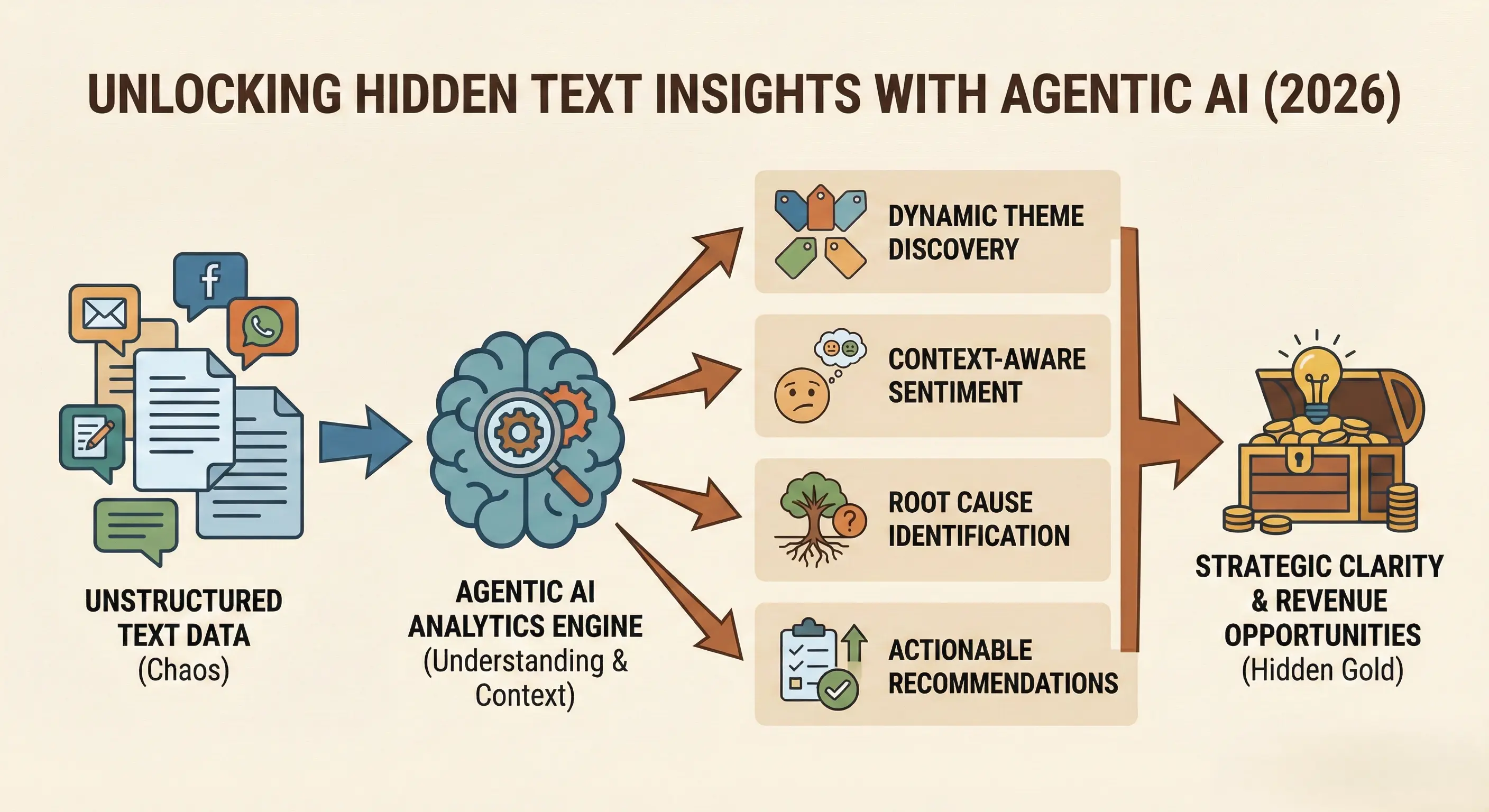
- Context-Aware Understanding: Recognizing that "too expensive" and "not worth the cost" are the same issue.
- Dynamic Theme Discovery: Clustering emerging themes without needing predefined rules.
- Root Cause Identification: Identifying why a problem is happening, not just that it exists.
How Agentic AI Unlocks Value
By implementing agentic systems, organizations can transform their workflow:
1. Context-Aware Understanding
Agentic AI eliminates fragmented insights by understanding nuances in language, ensuring that different phrasings of the same problem are grouped together.
2. Dynamic Theme Discovery
Instead of static categories, Agentic AI adapts as new issues emerge. If users suddenly start complaining about a new feature update, the system detects it automatically—no manual re-tagging required.
3. Real-Time Signal Detection
Agentic systems continuously scan incoming data. They surface early warning signs before problems escalate—giving teams a critical head start.
4. Action-Oriented Insights
Beyond analysis, agentic AI can recommend which issues to prioritize, where teams should intervene, and which feedback clusters impact retention or revenue most.
Practical Use Cases Across Industries
- Customer Experience: Automatically identify top frustration drivers across support tickets and surveys.
- Product Teams: Extract feature requests and usability complaints directly from user language.
- Marketing Teams: Monitor sentiment trends to adjust messaging before campaigns underperform.
- Internal Knowledge: Convert scattered documents into searchable knowledge bases.
Best Practices for Getting Started
To succeed with AI text analytics, start with clear business questions rather than just raw data. Combine AI insights with human validation, especially early on, and focus on extracting actionable themes rather than just vanity sentiment scores.
Final Thoughts: From Data Overload to Strategic Clarity
Your text data isn’t noise—it’s insight waiting to be uncovered. Agentic AI shifts teams away from manual digging and toward intelligent exploration.
Instead of reading thousands of comments, you understand patterns. Instead of reacting late, you act early. If you’re knee-deep in text overload, now is the time to rethink how you analyze it. Unlock the hidden gold. Let your text data work for you—not against you.