AI to Automate Your Text Analytics and Survey Response Analysis
In today’s data-driven world, organizations collect massive amounts of text every day—customer feedback, employee surveys, product reviews, social media comments, and support tickets. While collecting this data is easy, making sense of it is not.
Open-ended responses are rich in insight but difficult, slow, and expensive to analyze manually. This is where Artificial Intelligence (AI) is transforming text analytics and survey response analysis. AI enables businesses, researchers, and product teams to automatically extract patterns, sentiments, and actionable insights from unstructured text—at scale and with speed that humans alone cannot achieve.
This article explains how AI automates text analytics, how it works for survey responses, and how you can practically implement it, even without a large data science team.
What Is Text Analytics in Survey Analysis?
Text analytics is the process of converting unstructured text into structured data that can be analyzed. In surveys, this usually applies to open-ended questions, such as:
- “What did you like most about our product?”
- “What problems did you face?”
- “How can we improve our service?”
Traditionally, analyzing these answers required reading each response, tagging themes manually, and summarizing insights—an approach that does not scale beyond a few hundred responses. AI automates this process by using Natural Language Processing (NLP) and Machine Learning (ML) to understand language patterns, emotions, and meaning.
Why Manual Survey Analysis No Longer Scales
Manual analysis works for small studies, but it breaks down quickly when data volume increases. Key challenges include:
- Time-consuming review of thousands of responses.
- Human bias in interpreting feedback.
- Inconsistent tagging across different analysts.
- Delayed insights that slow down decision-making.
"AI solves these issues by delivering consistent, fast, and repeatable analysis that scales instantly with your data."
How AI Automates Text Analytics
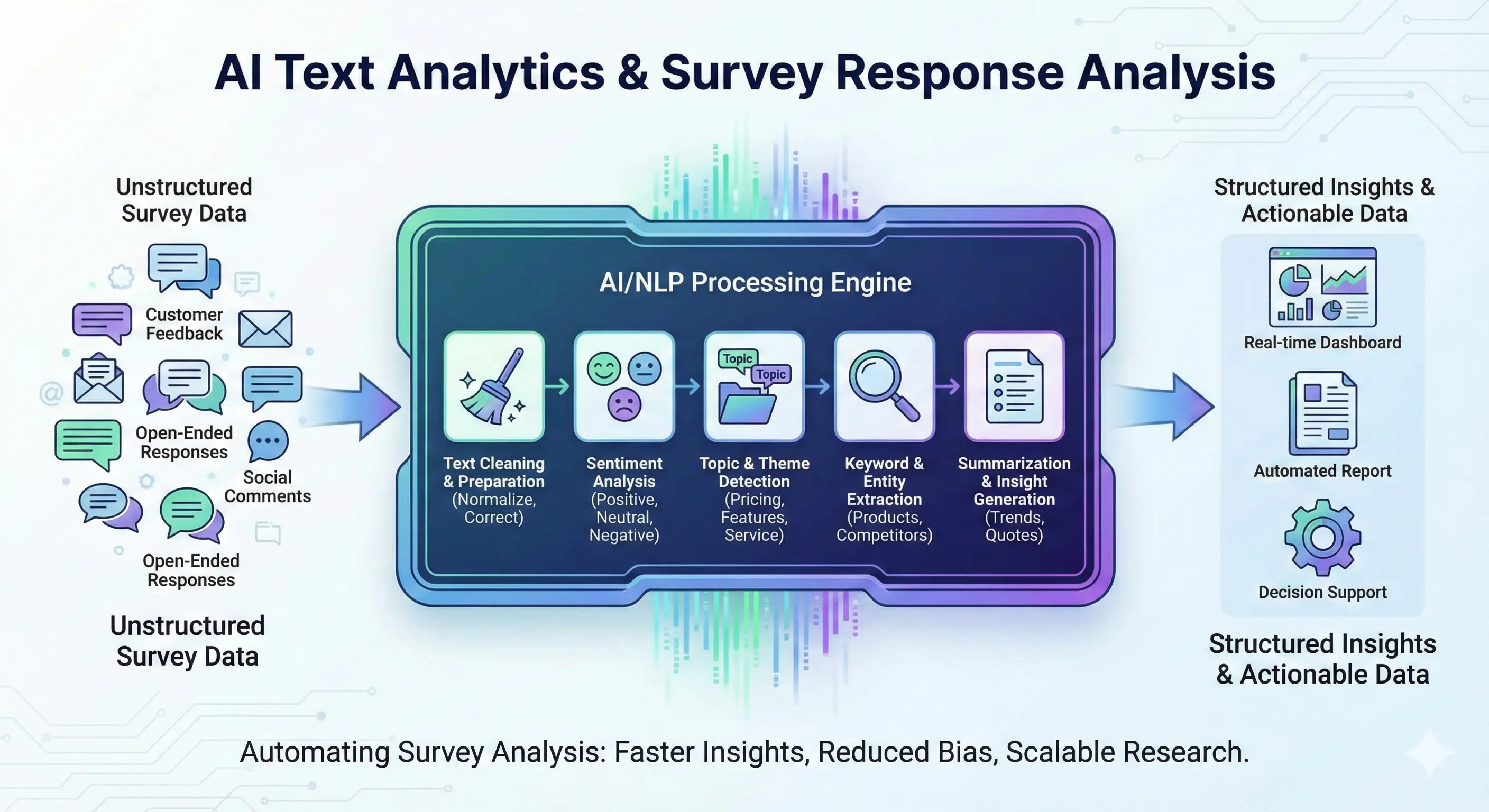
AI-driven text analytics follows a structured, automated workflow to turn chaos into clarity:
1. Text Cleaning and Preparation
AI systems first normalize the data by removing noise (extra symbols), correcting spelling, handling emojis, and detecting language (crucial for multilingual global surveys). Clean data dramatically improves accuracy.
2. Sentiment Analysis
Sentiment analysis identifies the emotional tone in responses: Positive, Negative, or Neutral. Advanced AI detects emotional layers like frustration, satisfaction, or excitement. This is especially useful for Net Promoter Score (NPS) and Customer Satisfaction (CSAT) surveys.
3. Topic and Theme Detection
AI automatically groups responses into themes such as Pricing, Delivery, or Feature Requests. Modern AI does not rely only on keywords—it understands context. For example, “too expensive,” “costly,” and “pricing is high” are intelligently grouped together.
4. Keyword and Entity Extraction
AI extracts critical entities like product names, competitors, and locations. This allows teams to measure how often specific issues are mentioned, helping with prioritization.
5. Summarization and Insight Generation
Instead of reading thousands of rows, AI generates short summaries for each theme and provides representative quotes. Executives get insights in minutes, not weeks.
Benefits of Using AI for Survey Response Analysis
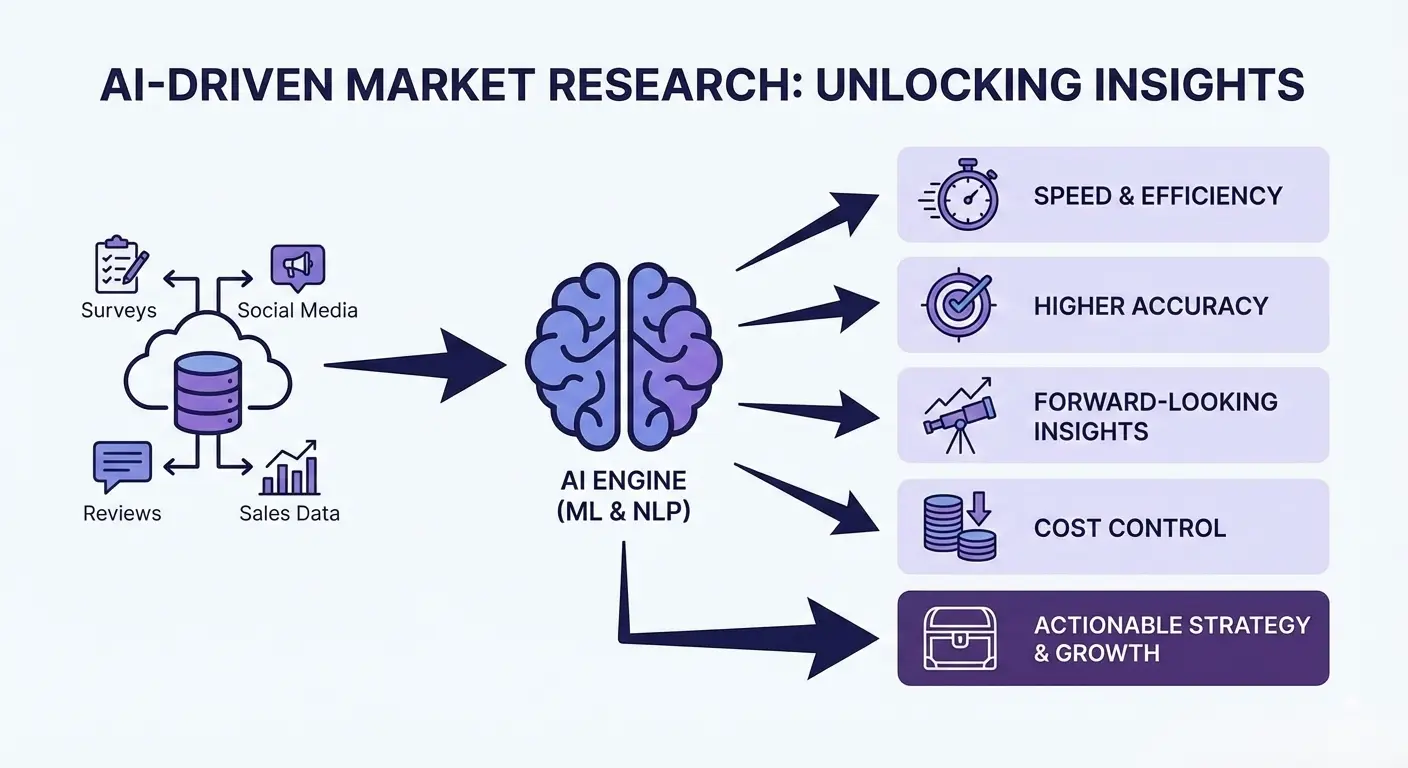
- Faster Insights: Process thousands of responses in minutes for real-time decisions.
- Higher Consistency: AI applies the same logic to every response, eliminating fatigue and bias.
- Scalable Research: Whether you have 100 or 100,000 responses, AI handles volume effortlessly.
- Cost Efficiency: Reduces the need for large manual coding teams.
- Better Decision-Making: Quantified feedback helps teams act with confidence.
Real-World Use Cases
AI text analytics is versatile across various business functions:
- Customer Feedback: Analyze reviews to find recurring complaints.
- Employee Engagement: HR teams track morale and burnout signals anonymously.
- Product Development: Prioritize features based on real customer feature requests.
- Market Research: Analyze brand perception and campaign effectiveness.
Best Practices for Accurate AI Analysis
To get reliable results, use human validation for early model testing and create clear categories aligned with business goals. Always combine AI with human review for sensitive decisions and preserve original quotes to maintain context.
Is AI Suitable for Small Businesses?
Yes. Many modern tools offer no-code dashboards, affordable pricing tiers, and easy integration with survey platforms. Even startups and individual researchers can now access enterprise-level analytics.
Conclusion
AI has fundamentally changed how organizations understand text data. What once took weeks of manual effort can now be done in minutes with greater consistency and depth. By automating text analytics and survey response analysis, businesses gain faster insights, reduce bias, and unlock the full value of customer and employee voices.